Fat prosperous cops with Chamber of Commerce voices
This type of character is depicted in a somewhat stereotypical and two-dimensional manner. The group of characters in question comprises Police Commissioner Randy Starr in The Long Goodbye, Chief of Police Wax in Farewell, My Lovely and Sheriff Petersen in The Long Goodbye.
Randy Starr is the proprietor of a casino in Las Vegas and maintains connections within the underworld. It is Bernie Ohls who later informs Marlowe that “Starr is police commissioner in Vegas.” (The Long Goodbye, p. 297)
In contrast, the characterisation of Chief Wax in Farewell, My Lovely is more prominent. The dialogue between Marlowe and Wax occupies an entire chapter of the novel. The office of Wax and its location already indicate his position. The office is located on the second floor of a building that is otherwise in a state of disrepair. The personnel in the outer office appear to be lacking in competence and motivation.
A stained wood desk was set far back like Mussolini’s

Wax’s office is of a considerable size, with three large windows affording views of the Pacific Ocean. The author makes use of a hyperbolic simile between the size of Chief Wax’s office and that of Benito Mussolini’s to emphasise the importance of Wax’s role as the Chief of police.
Consequently, Wax is depicted not only as a morally ambiguous and criminal figure, but also as a perpetrator of corruption who is perceived to have the support and backing of those in positions of authority.
Wax has amassed a considerable fortune as a result of his tenure in this position. He is observed to be wearing a diamond ring, a diamond pin, and an expensive suit (Farewell, My Lovely, p. 241). However, as Giudice1 correctly asserts, the two ships that Marlowe can observe through the windows at sea, where illicit gambling is conducted outside the three-mile zone and criminals are also concealed, indicate Brunette, their proprietor and the actual paramount criminal figure in Bay City.
Brunette co-financed the mayoral election and thus bought the cooperation of justice and police in Bay City so that they do not obstruct boat traffic from the mainland to his gambling ships. This means that Wax can also be manipulated, which is reflected in his descriptive name “Wax”, which can easily be kneaded into any shape. Marlowe mentions the name of his influential client, whereupon Wax takes out a pocket diary with telephone numbers of “campaign contributors” (Farewell, My Lovely, p. 246) to whom the mayor owes favours. The number of Marlowe’s client is also noted in it, whereupon Wax sends for Galbraith, whom Marlowe wants to question. Wax is thus sketched with a few strokes as a big crime boss, which is then ironically broken up by portraying him as a boss who himself has to comply with the demands of others.
You could meet Sheriff Petersen on his ranch in the San Fernando Valley. There he could always be reached. If you couldn’t reach him in person you could talk to one of his horses.
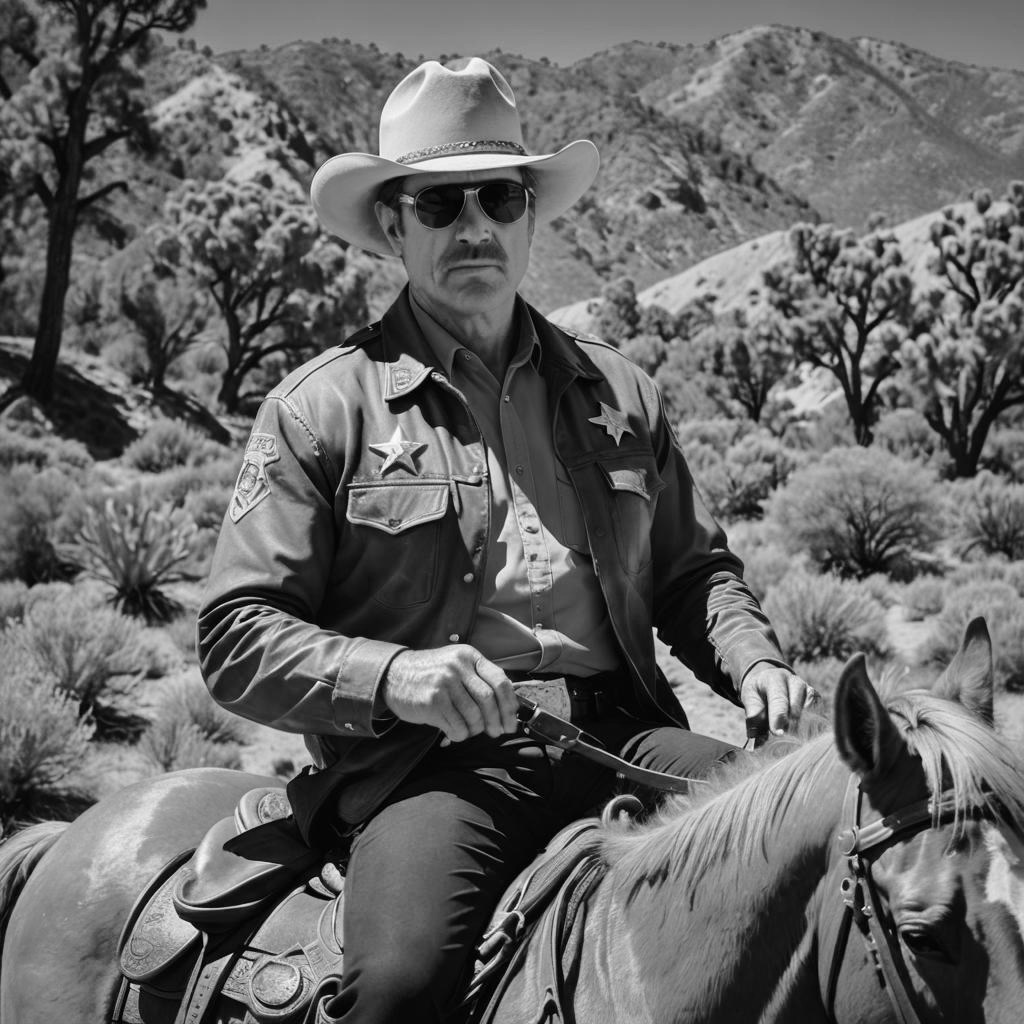
The character of Sheriff Petersen in The Long Goodbye can only be described as a caricature (hence the AI-generated photo). His department used to be corrupt, with Petersen managing to stay in the background while others carried out the illegal police actions. The extent to which Petersen was responsible for this is not mentioned in the text. He is now re-elected again and again, even though he is completely incompetent. He only allows himself to be photographed briefly by the press at his desk with a suspect for questioning, but after the photo session he leaves the questioning to other police officers.
“He was in his middle fifties and his father, a Dane, had left him a lot of money. The Sheriff didn’t look like a Dane, because his hair was dark and his skin was brown and he had the impassive poise of a cigar store Indian and about the same kind of brains. But nobody had ever called him a crook. There had been crooks in his department and they had fooled him as well as they had fooled the public, but none of the crookedness rubbed off on Sheriff Petersen. He just went right on getting elected without even trying, riding white horses at the head of parades, and questioning suspects in front of cameras. That’s what the captions said. As a matter of fact he never questioned anybody. He wouldn’t have known how. He just sat at his desk looking sternly at the suspect, showing his profile to the camera. The flash bulbs would go off, the camera men would thank the Sheriff deferentially, and the suspect would be removed not having opened his mouth, and the Sheriff would go home to his ranch in the San Fernando Valley. There he could always be reached. If you couldn’t reach in person you could talk to one of his horses.“
The Long Goodbye, pp.226f.
Despite his role as sheriff, which entails certain police functions, he is more preoccupied with parades, horses and his ranch, where he is consistently accessible. This is in stark contrast to his availability in the office.
Petersen’s persona is that of the archetypal American cowboy, a facade that is, however, undermined by the fact that he is not, in fact, a long-established American, but the son of a Dane. The reader is left with the impression that Petersen’s role is primarily representational and that he serves as a figurehead for the police in the eyes of the public. Petersen is arguably a vehicle for Chandler’s criticism of American society. His character stands out starkly from the other police figures in the six novels, with no counterpart in the other novels.
- Guidice, Renate. Darstellung und Funktion des Raumes im Romanwerk von Raymond Chandler. Frankfurt/M 1979, p. 81. ↩︎
 Raymond Chandler Dead men are heavier than broken hearts
Leave a comment …